How Do You Know When Switch Is Charging in Dock
How to choose your Nintendo Switch Charger: Challenging Misinformation About Charging Nintendo'south Latest Console, Part ii
Introduction
The March 2017 launch of the Nintendo Switch marked Nintendo's first production that has combined both its console and portable gaming ambitions. What may be a little more obscure, nevertheless, is that the Switch is also Nintendo'due south start product to prefer non-proprietary charging standards: USB Type C for the physical connector and USB Power Commitment for the charging protocol.

For the first time, consumers aren't tied downwards to one-off Nintendo charging connectors (betwixt the original Nintendo DS, the Nintendo DS Light, and the Nintendo DSi… there were three dissimilar charging connectors beyond six years). Nintendo now features the USB Type-C ("USB-C") connector on the Switch itself, the Switch dock, and in various accessories like the Pro Controller and Charging Grip. Now consumers tin utilise a common set of charging devices with the Switch that they may already have in their homes for their smartphones, tablets, laptops, and other devices. We are finally living the dream!

Well… not so fast.
The downside to joining the USB ecosystem is that information technology is one standard (grouping of standards) that needs to support thousands of different devices and their unique power and data needs. So even at its (theoretical) best, though adherence to USB standards ensures that chargers and devices won't ruin each other, at that place's a new consumer claiming of how to decide whether a item charger will piece of work optimally with a given device. Put more than simply, the Nintendo Switch using USB-C means that lots of chargers will "work" (and not destroy your Switch), although at present in that location are several variations on what works "well" and how well.
That's just the theory. Add onto that the reality that both USB-C and USB Power Delivery ("USB-PD") are relatively new standards, and so industry adoption is yet immature. Charging and device manufacturers are however struggling to become comfortable with specifications and become their implementations right — from bad cables, to bad chargers, to improperly combining proprietary charging protocols with USB-C/PD, to safe chargers marred by poor user experience and design. So, the manufacturer'due south markings (and the Amazon product titles) of chargers and cables have not always been accurate — frequently because of manufacturer misunderstanding or incompetence, and sometimes intentionally and deceptively…

And finally, add together on the final fact that the Nintendo Switch does not take all the power a charger might support. What'south causing the almost consumer confusion is that nosotros've grown accustomed to relying on the output markings/characterization of a charger to tell us how much power is sent. However, the Switch oftentimes requests less power than a charger is capable of delivering (more on this later). The consequence is that your 12W USB Type A ("USB-A") charger ends up only sending 7.5W to the Switch and your 15W USB-C charger only sends 10W.

This of course isn't technically new — current is always pulled not pushed, so a charger'south output markings has always only defined its upper limit of current it can provide. However, given the past several years of feel with smartphones, consumers have more often than not come to understand that a charger's listed current determines "how fast it is at charging." And for a diverseness of reasons, that dominion by and large worked with smartphones. But as the power demands over USB rise with laptops and now game consoles adopting it for power, so goes the range of power/current consumption possibilities.
So understandably, we are left with a tremendous amount of consumer confusion around how to pick the right charger for the Nintendo Switch. I've had a little more than experience with the USB-C and USB-PD ecosystem, having already gone through a year and a half of accessory growing pains with owning the Google Nexus 6P and Pixel Xl. So I wanted to put this resource together to hopefully shed a petty calorie-free on this topic for the potentially 2+ million new Nintendo Switch converts to USB-C. Even though there's a lot of teething and hardship effectually getting the ecosystem to the maturity of the old USB-A and micro-B where "it just works," I withal actually believe in this connector. We'll get in that location together!
"Expect I just want to know what to buy or if my charger is good"
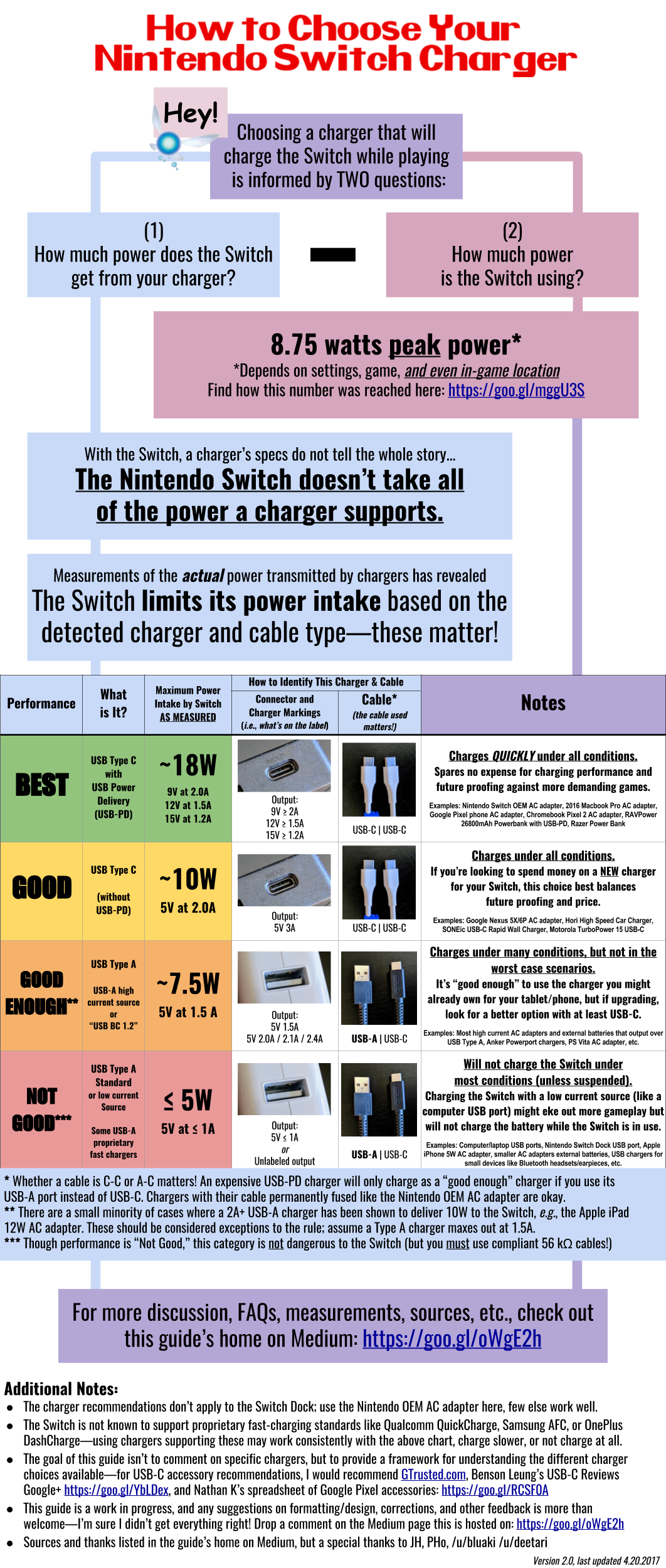
Okay let'due south get right into it. If later on looking at the infographic, you nonetheless want some fundamental instructions — I'll effort to boil this down into a few specific points of advice:
- The cheapest approach is to not purchase anything new. Y'all probably already take a USB-A car charger, external battery, or AC adapter that outputs at least 1.5A. Utilize information technology! When paired with a good USB A-C cable (similar the Nintendo one included with the Pro Controller/Charging Grip), this setup will exist "good enough," charging the Switch under many (merely not all) gameplay conditions. Buying any new charger with simply USB-A will accuse the same speed as your onetime USB-A charger.
- If you're looking to upgrade or buy new, but want to rest performance and toll, you should buy a USB Type C charger. Manifestly/standard USB-C chargers (5V 3A) are condign more than common and are coming downwardly in price. This kind of charger should reliably charge the Switch in all conditions.
- If you want to get the all-time/fastest charger possible, get a USB-C charger with USB-PD. Chargers with USB-PD will typically be more expensive, but will deliver the well-nigh power of any solution available (up to 18W) and will charge the Switch speedily, fifty-fifty with the virtually enervating of games. The voltage of your USB-PD charger is not quite as important here, as the charger can support 9V, 12V, or 15V (you don't need to match the Nintendo 15V 2.6A) and will still work smashing with the Switch.
- Bank check reviews of a production (Amazon reviews, Nathan K's spreadsheet, Benson Leung's G+ reviews page, Gtrusted.com) before you buy! USB-C is notwithstanding in its infancy and companies are not getting it all right yet.
That's about as simple every bit I tin can endeavor to get things — exercise know that the devil is in the details and in that location are lots of details, exceptions, and edge cases. The rest of this article and its companion manufactures unpack many of these details, and then I do encourage you to go along reading!
The deceptively easy formula to determining if a charger will charge the Switch while playing

To figure out whether the Switch's main battery will charge while playing a game, the formula quite like the one y'all might employ if you were looking to lose weight:
(A) Power From Charger - (B) Power Used = Battery gain/Battery loss
But much like the "calories in/out" formula, its deceptive simplicity obscures the complexity of what'due south really happening with charging. Let's hash out each of the two parts, A) "power from charger" and B) "power used" in plow.
A) The Switch does not take all of the power a charger supports
As mentioned in the introduction, one of the biggest sources of consumer confusion around charging the Switch is that it does non take all the power a charger might support. Thanks to today's smartphones, consumers have by and large come up to understand that a charger's listed current determines "how fast it is at charging." And for a multifariousness of reasons, that rule by and large worked with smartphones.
All the same, those of usa with voltage/electric current meters have discovered that the Switch often limits the amount of current it accepts, and so in many cases, relying on the output markings of a charger has misled consumers into assertive their charger supplies more than power than information technology does.
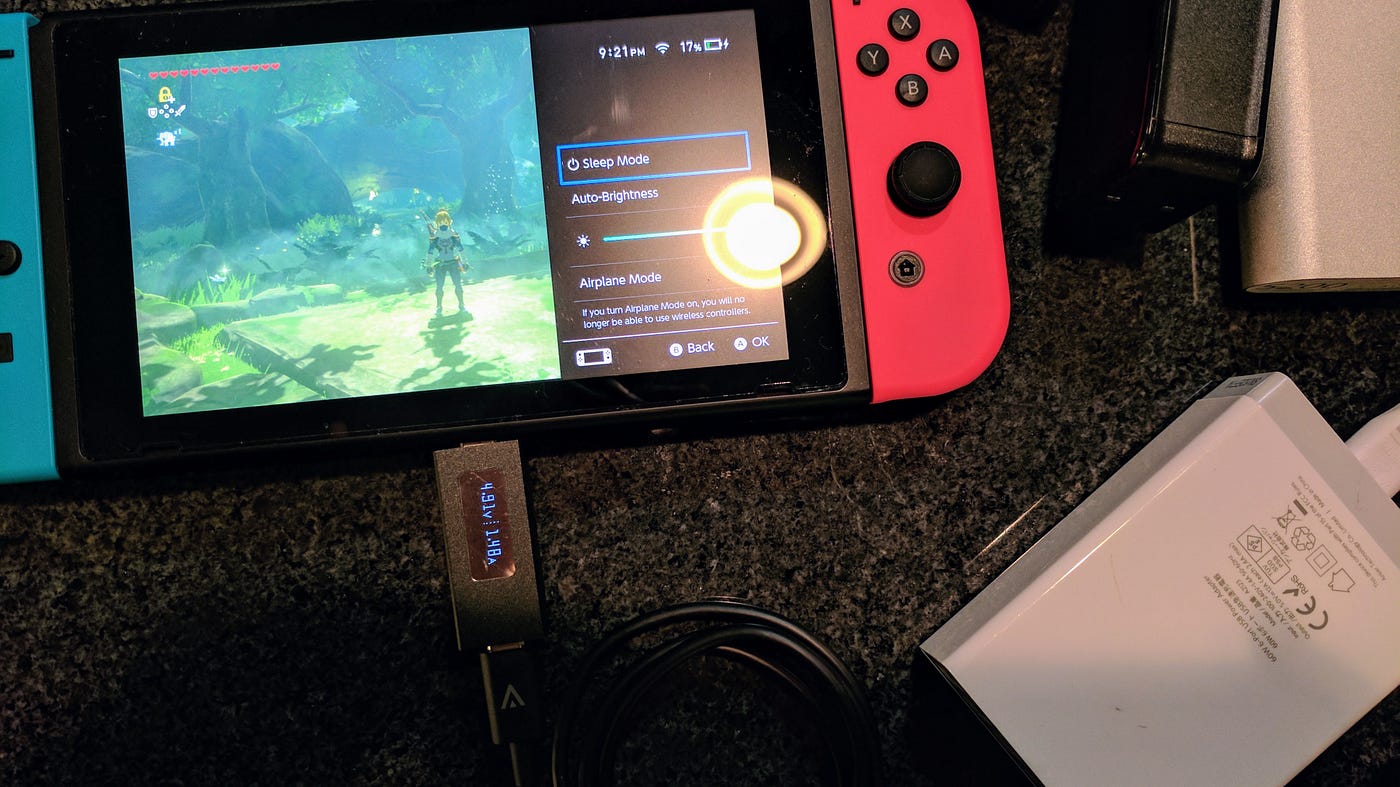
Based on the measurements of a few dozen different chargers across several folks with meters, in that location are three full general limitations on Switch power consumption to be enlightened of (that cover over xc% of cases):
- For USB-A, the corporeality of electric current the Switch will pull is limited to 1.5A, despite that many high current USB-A chargers back up 2.1–2.4A. This means that "all" USB-A chargers cease up only providing up to seven.5 watts (5V 1.5A) of power.
- For USB-C, the amount of current the Switch volition pull is express to 2A, despite that the vast majority (if not all) USB-C chargers are rated for 5V 3A. This means all regular USB-C chargers finish up just providing up to ten watts (5V two.0A) of power.
- For USB-PD, the amount of power the Switch will pull is limited to 18 watts. Then fifty-fifty though the Nintendo OEM AC Adapter provides up to 39 watts of power (15V 2.6A), the Switch volition notwithstanding only consume upwardly to eighteen watts, or 15V 1.2A. Oh, and the Switch'due south implementation of USB-PD ways that it too tin accept 9V and 12V USB-PD chargers just fine (previous assumptions that chargers needed to support the 15V of the Nintendo charger are incorrect). With whatever USB-PD voltage, the Switch will take as much current as results in 18 watts of ability.
These rules are nigh ironclad (run into "Exceptions and edge cases" below), and should be used as a rule of thumb when assuming the charging operation of a charger for your Nintendo Switch. To illustrate, your twelvemonth-old USB-A power bank that supplies 5V 2.4A will charge simply also as a fancy new $80 power bank with USB-A. Moreover, if yous buy a fancy new power banking company with USB-PD and employ your Nintendo Pro Controller cable (a USB A-C cable), once again y'all are charging no faster than the year-old power banking company.
I besides take a split up addendum article list the various chargers I've measured/tested to accomplish my conclusions.
(B) How much power does the Switch use? Stress testing the Switch
A lot of consumer confusion almost what chargers can properly charge the Switch also comes from a lack of precision when testing a charger with the Switch. Check out my comprehensive "stress testing" of the Switch here, in Office 1 of my series.
The end conclusion to my stress exam study is that in the most demanding case currently known (Korok Forest in BOTW), the Switch draws ~viii.75 watts.
Combining this data with the charging measurements from the higher up section, and a picture begins to class about how the different charging setups (USB-A, USB-C, and USB-PC) distinguish themselves from one another. The result is the infographic at the top of this article.
Exceptions and edge cases
Figuring all of this out wouldn't be a pain in the butt if there weren't exceptions to the rules I've outlined in a higher place. For the sake of transparency, I'll include any odd exceptions or edge cases hither, and update this section as nosotros learn about more than. With that said, I'm pretty confident my generalizations hold upwards in more than than 90% of the cases (and hither's my discussion of why).
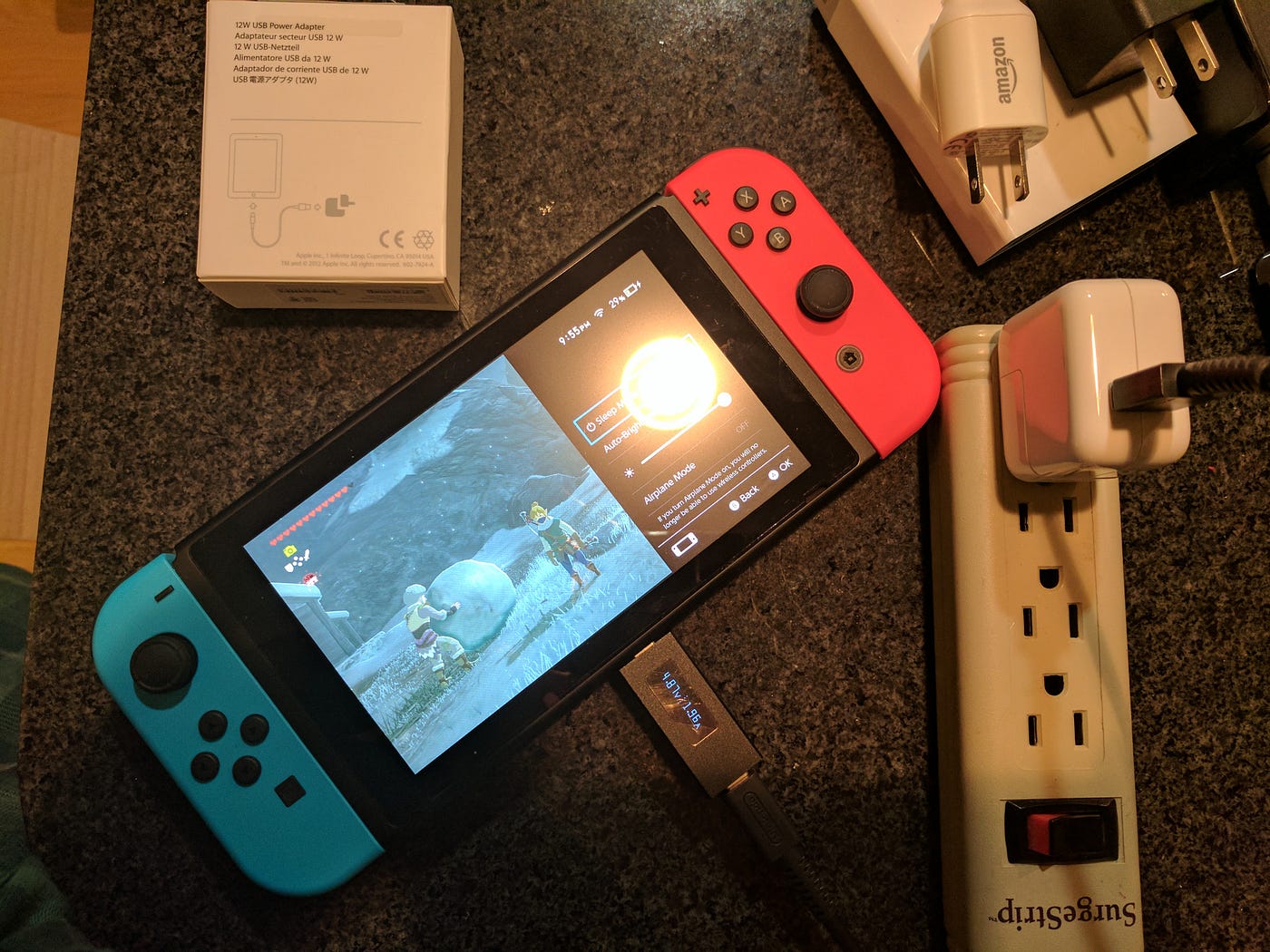
There are only two known cases of a USB-A charger delivering more than than 1.5A to the Switch. The biggest exception here is the popular Apple tree 12W iPad USB-A charger which actually provides 2A to the Switch. The other is a Chinese "build-information technology-yourself" power banking concern, the Soshine 10400mAh. It'south not articulate why these chargers provide more than 1.5A, but the 1.5A limitation seems to otherwise concord beyond many, many USB-A chargers.
Also of note, if using a non-compliant USB A-C cablevision (i.eastward., without the 56 kΩ pull-up resistor), you tin can also get the Switch to draw 2A from your typical ii.iv A USB-A charger. It'due south harder to find non-compliant cables like this now, (though they were prolific back in late 2015). Though it may be tempting to observe and utilize ane in order to get an extra 2.5 watts out of your USB-A charger, it'due south risky to have effectually. For if you utilise it with a power supply that supports less than 2A (similar a computer USB port or the Switch Dock's USB port) y'all will risk an overcurrent situation which may harm your equipment.
Some chargers with proprietary fast-charging standards similar Samsung'due south Adaptive Fast Charging don't seem to play squeamish with the Switch over a USB A-C cable and fallback to a very slow legacy-condom mode where only 5V 0.5A (2.5W) is sent, and this is definitely is in very slow, "not skillful" charging territory.
On the power/wattage limit of the Nintendo Switch, a compelling case for the Switch maxing out at xviii watts was set forth by AnandTech — the maximum output of the Switch Dock is stated to exist eighteen watts, so information technology would be reasonable that the Switch would non attempt to pull more than that, lest it causes an overcurrent situation while charging in the dock. However, in that location have been some reported instances of the Switch pulling more than 18 watts, including past me. As a practical matter, information technology may not brand much deviation considering xviii watts is more than than plenty to quickly accuse the Switch, but this will be something I go along monitoring in terms of an explanation.
Frequently Asked Questions
Additional FAQs to exist added here.
Q: Don't I need a charger that matches the 15V 2.6A of the Nintendo OEM AC adapter?
A: No. here was some early (pre-launch) belief that the Nintendo Switch required the same 15V 2.6A as the Nintendo OEM AC adapter to charge the Switch, so reports from ArsTechnica and The Verge that 5v bombardment packs may not be enough to charge the Switch while playing led some to quickly conclude it was the lack of 15V that was the cause. We at present know this to be untrue, and the Switch can be charged with 5V / 9V / 12V / 15V.
friendtherinceple.blogspot.com
Source: https://medium.com/@clumsycontraria/how-to-choose-your-nintendo-switch-charger-d0ebd84afdf9
0 Response to "How Do You Know When Switch Is Charging in Dock"
Post a Comment